By Lauren Scott
•
August 31, 2026
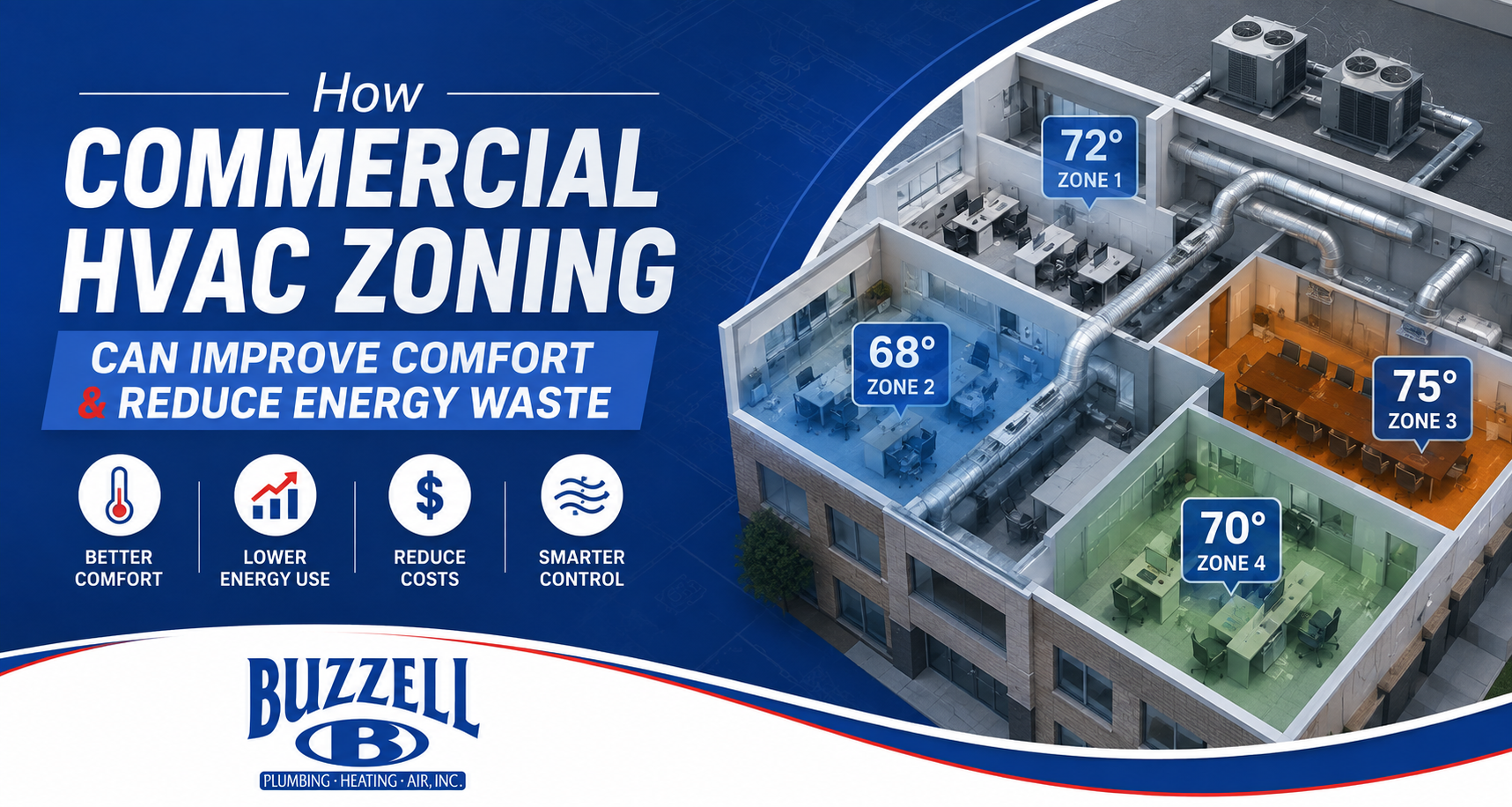
Maintaining comfortable temperatures throughout a commercial building can be more complicated than simply setting the thermostat. One area may feel too warm while another feels too cold. Conference rooms can heat up quickly when they are full, while storage areas may require much less heating and cooling. Offices near large windows may also experience very different conditions than interior spaces. These temperature differences can create comfort complaints and cause HVAC equipment to work harder than necessary. For some commercial properties, HVAC zoning can provide greater control over how heating and cooling are distributed throughout the building. Understanding how commercial HVAC zoning works can help business owners and facility managers determine whether zoning or other HVAC improvements could provide better comfort, efficiency, and control. What Is Commercial HVAC Zoning? Commercial HVAC zoning divides a building into separate areas, or zones, that can be managed according to their individual heating and cooling requirements. Instead of treating an entire building as one space, zoning allows different areas to receive heating or cooling based on factors such as occupancy, operating schedules, building layout, and temperature requirements. Depending on the HVAC system and facility, zoning may incorporate multiple thermostats, sensors, dampers, variable air volume components, building controls, or separate HVAC equipment. For example, an office building could have separate zones for conference rooms, individual offices, common areas, and storage spaces. A retail property might divide customer areas, offices, stockrooms, and other spaces into different zones. The exact approach depends on the building and its existing HVAC infrastructure. Why Do Commercial Buildings Develop Hot and Cold Spots? Uneven temperatures are common in commercial buildings because different areas rarely have identical heating and cooling requirements. Several factors can contribute to temperature differences throughout a facility. Occupancy levels: A busy conference room or customer area can generate significantly more heat than an empty office or storage space. Sun exposure: Areas with large windows or significant afternoon sunlight may become warmer than interior portions of the building. Equipment: Computers, commercial appliances, machinery, lighting, and other equipment can add heat to certain spaces. Building layout: Multi-story properties, additions, high ceilings, open spaces, and enclosed offices can all affect airflow and temperature distribution. Operating schedules: Some portions of a building may be occupied for much longer periods than others. However, zoning is not automatically the solution to every hot or cold spot. Uneven temperatures can also indicate airflow restrictions, ductwork problems, improperly sized equipment, malfunctioning controls, or HVAC equipment that needs service. A professional evaluation can help identify the actual cause before changes are made. How Can Commercial HVAC Zoning Reduce Energy Waste? One of the biggest potential advantages of zoning is having greater control over where and when conditioned air is needed. Consider a commercial building where employees primarily work in offices during the day, but a large conference area is used only occasionally. Treating both areas exactly the same can result in unnecessary heating or cooling. With properly designed zoning and controls, HVAC operation can better reflect how different areas of the building are actually being used. Zoning can also help address spaces with naturally different temperature requirements. An interior office may need less cooling than a west-facing conference room receiving afternoon sunlight. Instead of repeatedly adjusting a single thermostat in an attempt to satisfy every part of the building, zoning provides more precise temperature management. Reducing unnecessary HVAC operation may help businesses lower energy waste while maintaining comfortable conditions where they are needed. Additional Benefits of Commercial HVAC Zoning Energy management is only one reason businesses may consider zoning. A properly designed system can provide several other benefits. Improved Occupant Comfort Employees and customers can quickly notice uncomfortable building temperatures. When different areas can be controlled independently, businesses have greater flexibility to maintain appropriate conditions throughout their facility. Greater Temperature Control Commercial properties frequently contain spaces with very different purposes. Zoning gives facility managers more control over those differences rather than relying on one temperature setting for an entire building. Better Adaptability The way a commercial property is used can change over time. Offices may be reconfigured, departments can move, operating hours may change, or previously unused areas can become occupied. The right HVAC controls can make it easier to adapt temperature management as the facility evolves. Reduced Unnecessary HVAC Runtime When the entire building does not need the same amount of conditioning at the same time, zoning can help reduce unnecessary heating and cooling. This may also decrease avoidable strain on certain HVAC components. What Types of Commercial Buildings Can Benefit From HVAC Zoning? Zoning can be useful in many types of commercial facilities, but it is particularly worth evaluating when a property contains areas with substantially different usage patterns. Office buildings are a good example. Private offices, conference rooms, break rooms, lobbies, and open workspaces may all experience different occupancy and heat loads throughout the day. Retail facilities may have different requirements between customer-facing spaces, offices, storage areas, and stockrooms. Warehouses and manufacturing facilities can have even greater differences between office areas, production spaces, loading areas, and storage environments. Healthcare facilities, educational buildings, restaurants, and mixed-use properties can also have spaces that require different levels of temperature control. The important factor is not necessarily the type of building. It is how the individual areas within that building are used. Is HVAC Zoning Right for Every Commercial Building? Not necessarily. Before investing in zoning changes, businesses should determine why they are experiencing temperature or efficiency problems in the first place. If a building has poor airflow because of blocked ductwork, for example, installing additional controls may not correct the underlying issue. The same applies to dirty equipment, incorrectly sized HVAC systems, failing components, damaged ductwork, or outdated controls. A commercial HVAC assessment can examine equipment condition, airflow, building layout, operating schedules, occupancy patterns, thermostat placement, and other factors that influence performance. In some cases, relatively straightforward repairs or adjustments may improve comfort. Other buildings may benefit from control upgrades, equipment retrofits, zoning improvements, or a larger HVAC system redesign. Identifying the cause first helps businesses avoid investing in a solution that does not address the actual problem. Zoning Should Be Part of a Larger HVAC Strategy Commercial HVAC performance depends on more than temperature settings alone. Equipment condition, preventive maintenance, ventilation, indoor air quality, airflow, controls, and system design all affect how efficiently and reliably a building operates. That means zoning should be considered as part of the building's overall HVAC strategy rather than as an isolated upgrade. Businesses should also consider how their building is likely to change in the future. If a facility is being renovated, expanded, or reconfigured, it may be an ideal time to evaluate whether the existing HVAC layout still matches the way the property is being used. Planning ahead can help ensure HVAC improvements support both current requirements and future growth. Improve Your Commercial Building's HVAC Performance If your commercial property struggles with uneven temperatures, excessive HVAC runtime, or areas with very different heating and cooling needs, it may be time to evaluate how your system is distributing conditioned air. Buzzell Plumbing, Heating & Air provides commercial HVAC installation, repair, maintenance, and system support for businesses throughout Middle Georgia. Our team can evaluate your existing equipment and building requirements to identify solutions designed around your facility. Contact Buzzell Plumbing, Heating & Air today to learn how professional commercial HVAC services can help improve comfort, efficiency, and system performance throughout your building.