Preventive HVAC & Plumbing Maintenance for Senior Living Facilities

Lauren Scott • October 6, 2026

Preventive HVAC & Plumbing Maintenance for Senior Living Facilities
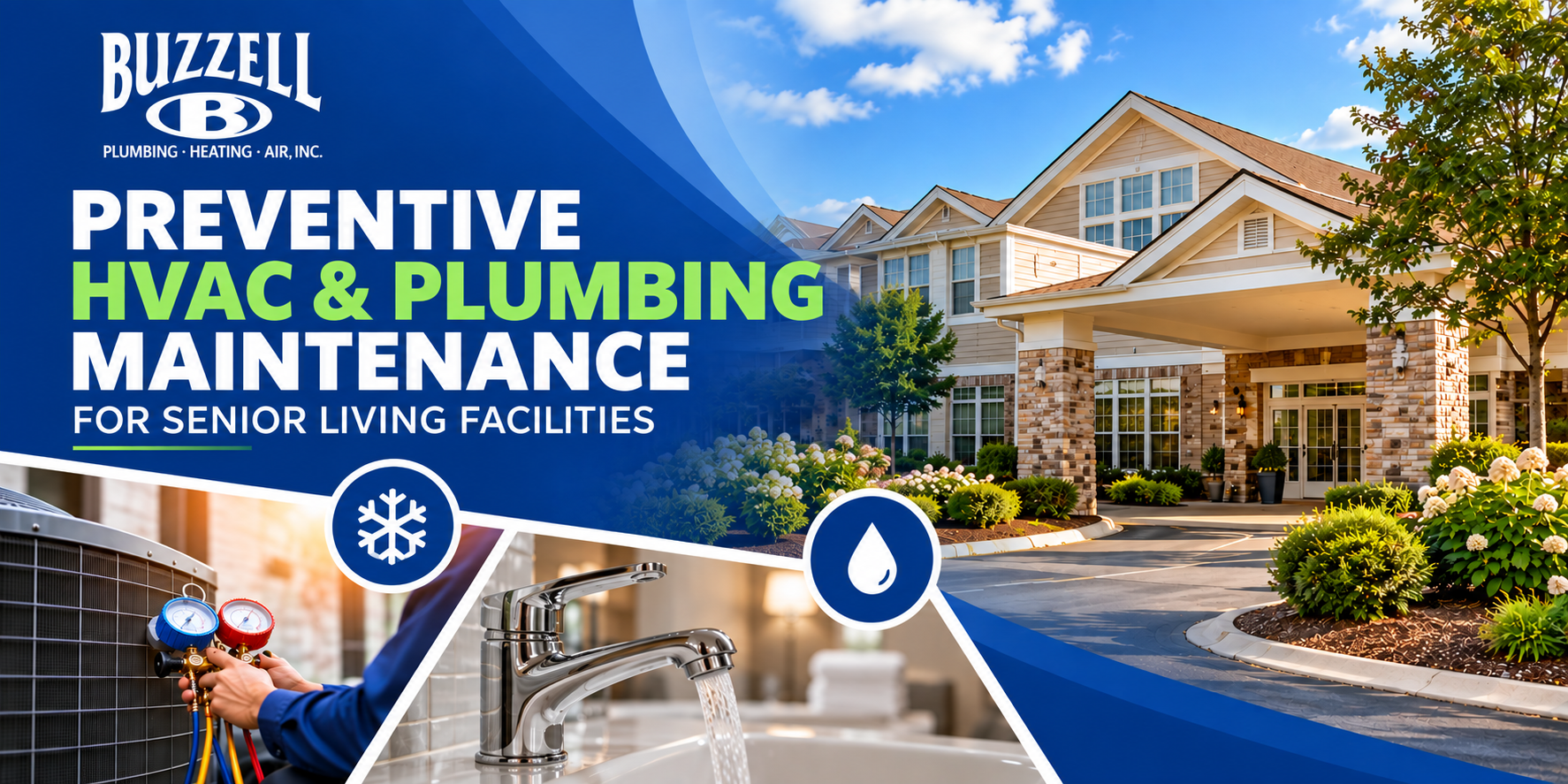

Senior living communities, nursing homes, rehabilitation centers, and long-term care facilities operate around the clock. Unlike many commercial buildings that empty out at the end of the workday, these facilities depend on reliable heating, cooling, and plumbing systems at virtually all times.


An HVAC failure can quickly create uncomfortable conditions in resident rooms and common areas. A plumbing problem can affect restrooms, kitchens, laundry areas, water heaters, and other essential parts of daily operations. For facility managers, waiting until something breaks can create unnecessary disruptions and unexpected expenses.


A proactive maintenance strategy can help identify developing problems earlier, keep equipment operating more reliably, and make future repairs and replacements easier to plan.


For facilities throughout Middle Georgia, Buzzell Plumbing, Heating & Air provides commercial HVAC and plumbing services for hospitality facilities, including senior living communities, nursing homes, rehabilitation centers, and long-term care facilities.


Why Senior Living Facilities Have Different HVAC and Plumbing Demands


Every commercial property depends on its mechanical systems, but senior living facilities present additional challenges.

Resident rooms, dining spaces, kitchens, offices, rehabilitation areas, hallways, and common areas can all have different heating and cooling requirements. Occupancy also remains relatively consistent throughout the day and night, meaning HVAC systems may operate for longer periods than they would in a traditional office environment.


Plumbing systems experience similar demands. Toilets, sinks, showers, kitchens, laundry facilities, water heaters, and other fixtures may see frequent use throughout the day.


That makes preventive maintenance particularly important. Rather than treating HVAC and plumbing as systems that only require attention after a failure, facility managers can monitor their condition and address smaller problems before they interfere with operations.


HVAC Maintenance Priorities for Senior Living Facilities


Maintaining comfortable indoor temperatures is one of the most visible responsibilities of an HVAC system in a senior living facility.


However, maintaining a commercial HVAC system involves much more than checking whether the building feels warm or cool.

Professional commercial heating and air conditioning service can include filter replacement, coil cleaning, refrigerant checks, belt inspections, electrical testing, thermostat calibration, airflow balancing, ventilation inspections, and equipment performance evaluations.


Regular inspections can also reveal gradual performance changes that might otherwise go unnoticed.


For example, a system may still be running while struggling to distribute conditioned air evenly. One wing might become warmer than another, or certain resident rooms may consistently feel uncomfortable.


As discussed in Buzzell's guide to common causes of hot and cold spots in commercial buildings, uneven temperatures can result from airflow restrictions, ductwork problems, controls, equipment performance, building changes, and other factors.

Investigating these problems early can help facility managers address the underlying cause rather than continually adjusting thermostats.


Plumbing Systems Need Preventive Attention Too


HVAC equipment isn't the only mechanical system that benefits from proactive maintenance.


Senior living and long-term care facilities place significant demands on their plumbing infrastructure. Even a relatively minor problem can become disruptive when it affects an area used by many residents or staff members.


Buzzell's commercial plumbing services include plumbing system inspections, leak detection, drain inspections, water pressure testing, valve inspections, water heater maintenance, fixture inspections, and preventive drain service.


Facility managers should pay particular attention to recurring issues.


A drain that repeatedly slows down, a toilet that frequently requires repairs, fluctuating water pressure, or a water heater that struggles to keep up with demand may indicate a larger problem developing within the system.


Water leaks deserve immediate attention as well. A small leak can waste water and potentially damage surrounding building materials if it continues unnoticed.


Regular plumbing inspections provide an opportunity to identify these concerns before they become more difficult or expensive to address.


Don't Overlook Commercial Water Heaters


Hot water is essential to many daily activities within senior living and care facilities.


Depending on the property, water heaters may support resident rooms, kitchens, laundry operations, cleaning, and other facility needs. Equipment that receives heavy use should not be expected to operate indefinitely without attention.


Preventive water heater service may include inspections, tank flushing, thermostat testing, heating element inspections, pressure relief valve inspections, and recirculation system service.


Facility managers should also track the age and repair history of water-heating equipment. Increasing repair frequency or declining performance can provide an opportunity to begin planning for an eventual replacement instead of waiting for an unexpected failure.


The Cost of Waiting Until Something Breaks


Reactive maintenance can seem reasonable when equipment appears to be operating normally. Unfortunately, many HVAC and plumbing problems develop gradually.


A worn HVAC belt, dirty coil, restricted filter, small leak, deteriorating valve, or partially obstructed drain may not immediately cause a system failure. Left unaddressed, however, smaller issues can contribute to larger repairs.


Buzzell discusses this problem in The Cost of Deferred Commercial HVAC Maintenance, including how neglected maintenance can contribute to higher operating costs, unexpected downtime, reduced equipment life, and less predictable facility budgets.

For senior living facilities, downtime can be particularly difficult because operations cannot simply stop while repairs are completed.


Preventive maintenance does not eliminate every possibility of equipment failure, but it can give facility managers greater visibility into system condition and help reduce avoidable surprises.


Know When Repair Is No Longer the Best Option


Maintenance is important, but every piece of mechanical equipment eventually reaches a point where continued repairs may no longer make financial sense.


Facility managers should track equipment age, maintenance history, repair frequency, performance, and operating costs.

Buzzell's article on commercial HVAC asset management explains how maintaining detailed equipment records can help businesses plan repairs and replacements more strategically.


Warning signs that an HVAC system may require a larger evaluation can include recurring breakdowns, rising operating costs, declining performance, difficulty maintaining consistent temperatures, and increasingly expensive repairs.


When replacement becomes necessary, professional commercial HVAC installation can account for factors such as facility size, layout, occupancy, ventilation requirements, and the demands placed on different areas of the property.


Planning ahead gives facility managers more time to evaluate their options and budget for equipment replacement instead of making a rushed decision after a major failure.


Build a Preventive Maintenance Plan Around Your Facility


There is no single maintenance schedule that works for every senior living facility.


Equipment type, age, occupancy, operating hours, building size, system condition, and previous repair history can all influence how frequently systems should be evaluated.


A preventive maintenance strategy should include an inventory of major HVAC and plumbing equipment, scheduled inspections, maintenance records, repair histories, and anticipated replacement timelines.


Facilities can also consider a commercial maintenance agreement to create a more consistent approach to ongoing HVAC and plumbing care.


The goal is to move away from reacting to every problem individually and toward understanding the overall condition of the facility's mechanical systems.


Keep Your Senior Living Facility Prepared


Reliable HVAC and plumbing systems support more than the building itself. They help create a comfortable, dependable environment for residents, staff members, and visitors.


Routine maintenance can help facility managers identify developing problems, reduce unexpected breakdowns, manage equipment more strategically, and prepare for future repair and replacement needs.


Buzzell Plumbing, Heating & Air has served Middle Georgia since 1974 and provides commercial HVAC and plumbing solutions for nursing homes, assisted living communities, senior living facilities, rehabilitation centers, and long-term care facilities.

From preventive maintenance and repairs to equipment upgrades and installations, Buzzell can help keep essential building systems operating reliably.


Learn more about HVAC and plumbing services for hospitality and senior living facilities or contact Buzzell Plumbing, Heating & Air to discuss the needs of your facility.
Buzzell technician providing air conditioning repair in Warner Robins, GA
By Lauren Scott • September 29, 2026
Need AC repair? Learn how to choose an air conditioning company in Warner Robins, GA for reliable service, repairs, maintenance, and installation.
Buzzell plumber inspecting pipes under a sink for signs of a main sewer line problem.
By Lauren Scott • September 23, 2026
Slow drains throughout your home may signal a sewer line problem. Learn six warning signs and when to call a professional plumber.
By Lauren Scott • September 14, 2026
Wondering when to repipe a house? Learn 7 signs your plumbing pipes may need replacement and when to call Buzzell for repiping services.
By Lauren Scott • September 8, 2026
Discover 7 common causes of hot and cold spots in commercial buildings and how professional HVAC service can improve airflow, comfort, and efficiency.
By Lauren Scott • August 31, 2026
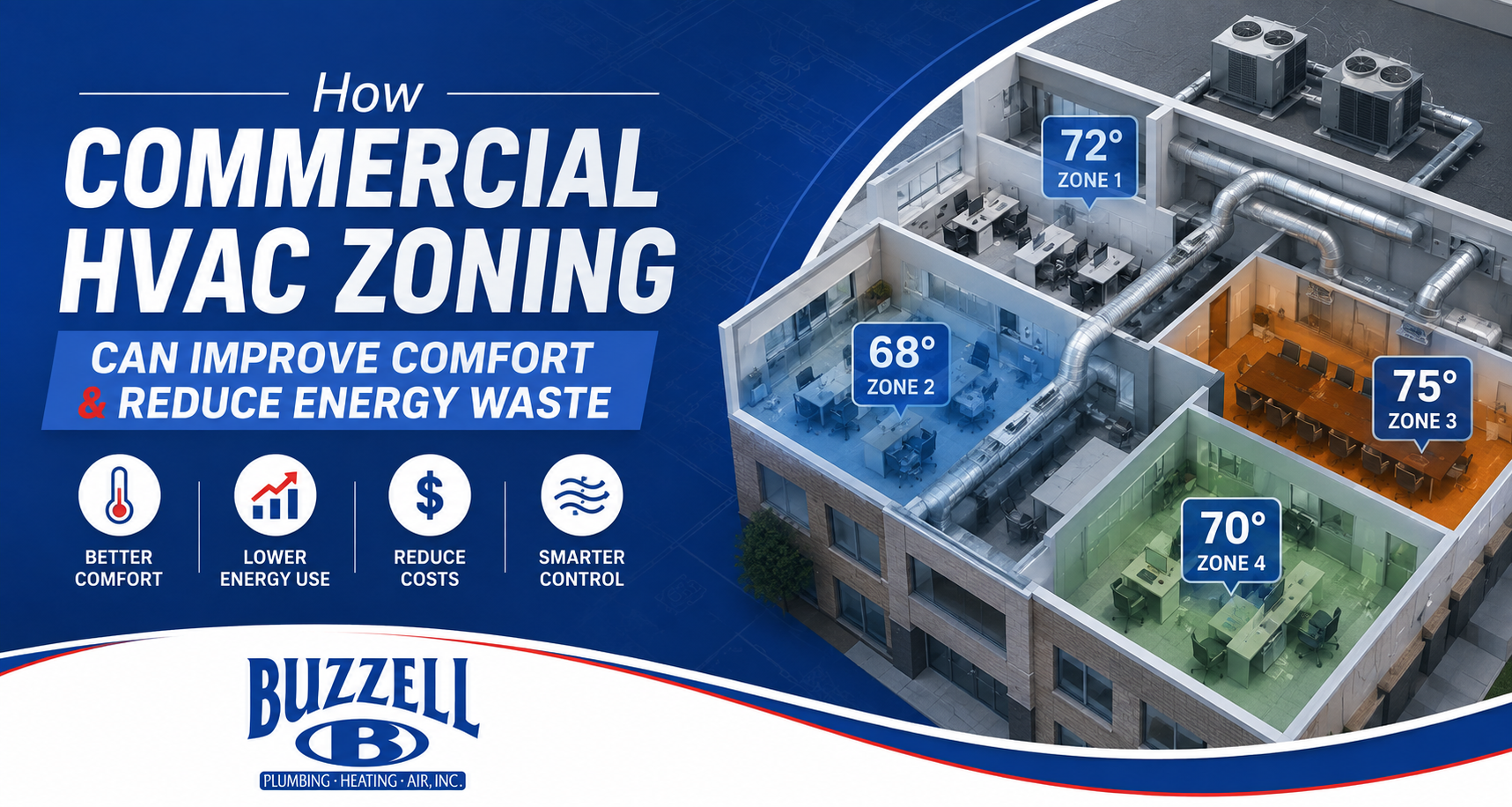
Maintaining comfortable temperatures throughout a commercial building can be more complicated than simply setting the thermostat. One area may feel too warm while another feels too cold. Conference rooms can heat up quickly when they are full, while storage areas may require much less heating and cooling. Offices near large windows may also experience very different conditions than interior spaces. These temperature differences can create comfort complaints and cause HVAC equipment to work harder than necessary. For some commercial properties, HVAC zoning can provide greater control over how heating and cooling are distributed throughout the building. Understanding how commercial HVAC zoning works can help business owners and facility managers determine whether zoning or other HVAC improvements could provide better comfort, efficiency, and control. What Is Commercial HVAC Zoning? Commercial HVAC zoning divides a building into separate areas, or zones, that can be managed according to their individual heating and cooling requirements. Instead of treating an entire building as one space, zoning allows different areas to receive heating or cooling based on factors such as occupancy, operating schedules, building layout, and temperature requirements. Depending on the HVAC system and facility, zoning may incorporate multiple thermostats, sensors, dampers, variable air volume components, building controls, or separate HVAC equipment. For example, an office building could have separate zones for conference rooms, individual offices, common areas, and storage spaces. A retail property might divide customer areas, offices, stockrooms, and other spaces into different zones. The exact approach depends on the building and its existing HVAC infrastructure. Why Do Commercial Buildings Develop Hot and Cold Spots? Uneven temperatures are common in commercial buildings because different areas rarely have identical heating and cooling requirements. Several factors can contribute to temperature differences throughout a facility. Occupancy levels: A busy conference room or customer area can generate significantly more heat than an empty office or storage space. Sun exposure: Areas with large windows or significant afternoon sunlight may become warmer than interior portions of the building. Equipment: Computers, commercial appliances, machinery, lighting, and other equipment can add heat to certain spaces. Building layout: Multi-story properties, additions, high ceilings, open spaces, and enclosed offices can all affect airflow and temperature distribution. Operating schedules: Some portions of a building may be occupied for much longer periods than others. However, zoning is not automatically the solution to every hot or cold spot. Uneven temperatures can also indicate airflow restrictions, ductwork problems, improperly sized equipment, malfunctioning controls, or HVAC equipment that needs service. A professional evaluation can help identify the actual cause before changes are made. How Can Commercial HVAC Zoning Reduce Energy Waste? One of the biggest potential advantages of zoning is having greater control over where and when conditioned air is needed. Consider a commercial building where employees primarily work in offices during the day, but a large conference area is used only occasionally. Treating both areas exactly the same can result in unnecessary heating or cooling. With properly designed zoning and controls, HVAC operation can better reflect how different areas of the building are actually being used. Zoning can also help address spaces with naturally different temperature requirements. An interior office may need less cooling than a west-facing conference room receiving afternoon sunlight. Instead of repeatedly adjusting a single thermostat in an attempt to satisfy every part of the building, zoning provides more precise temperature management. Reducing unnecessary HVAC operation may help businesses lower energy waste while maintaining comfortable conditions where they are needed. Additional Benefits of Commercial HVAC Zoning Energy management is only one reason businesses may consider zoning. A properly designed system can provide several other benefits. Improved Occupant Comfort Employees and customers can quickly notice uncomfortable building temperatures. When different areas can be controlled independently, businesses have greater flexibility to maintain appropriate conditions throughout their facility. Greater Temperature Control Commercial properties frequently contain spaces with very different purposes. Zoning gives facility managers more control over those differences rather than relying on one temperature setting for an entire building. Better Adaptability The way a commercial property is used can change over time. Offices may be reconfigured, departments can move, operating hours may change, or previously unused areas can become occupied. The right HVAC controls can make it easier to adapt temperature management as the facility evolves. Reduced Unnecessary HVAC Runtime When the entire building does not need the same amount of conditioning at the same time, zoning can help reduce unnecessary heating and cooling. This may also decrease avoidable strain on certain HVAC components. What Types of Commercial Buildings Can Benefit From HVAC Zoning? Zoning can be useful in many types of commercial facilities, but it is particularly worth evaluating when a property contains areas with substantially different usage patterns. Office buildings are a good example. Private offices, conference rooms, break rooms, lobbies, and open workspaces may all experience different occupancy and heat loads throughout the day. Retail facilities may have different requirements between customer-facing spaces, offices, storage areas, and stockrooms. Warehouses and manufacturing facilities can have even greater differences between office areas, production spaces, loading areas, and storage environments. Healthcare facilities, educational buildings, restaurants, and mixed-use properties can also have spaces that require different levels of temperature control. The important factor is not necessarily the type of building. It is how the individual areas within that building are used. Is HVAC Zoning Right for Every Commercial Building? Not necessarily. Before investing in zoning changes, businesses should determine why they are experiencing temperature or efficiency problems in the first place. If a building has poor airflow because of blocked ductwork, for example, installing additional controls may not correct the underlying issue. The same applies to dirty equipment, incorrectly sized HVAC systems, failing components, damaged ductwork, or outdated controls. A commercial HVAC assessment can examine equipment condition, airflow, building layout, operating schedules, occupancy patterns, thermostat placement, and other factors that influence performance. In some cases, relatively straightforward repairs or adjustments may improve comfort. Other buildings may benefit from control upgrades, equipment retrofits, zoning improvements, or a larger HVAC system redesign. Identifying the cause first helps businesses avoid investing in a solution that does not address the actual problem. Zoning Should Be Part of a Larger HVAC Strategy Commercial HVAC performance depends on more than temperature settings alone. Equipment condition, preventive maintenance, ventilation, indoor air quality, airflow, controls, and system design all affect how efficiently and reliably a building operates. That means zoning should be considered as part of the building's overall HVAC strategy rather than as an isolated upgrade. Businesses should also consider how their building is likely to change in the future. If a facility is being renovated, expanded, or reconfigured, it may be an ideal time to evaluate whether the existing HVAC layout still matches the way the property is being used. Planning ahead can help ensure HVAC improvements support both current requirements and future growth. Improve Your Commercial Building's HVAC Performance If your commercial property struggles with uneven temperatures, excessive HVAC runtime, or areas with very different heating and cooling needs, it may be time to evaluate how your system is distributing conditioned air. Buzzell Plumbing, Heating & Air provides commercial HVAC installation, repair, maintenance, and system support for businesses throughout Middle Georgia. Our team can evaluate your existing equipment and building requirements to identify solutions designed around your facility. Contact Buzzell Plumbing, Heating & Air today to learn how professional commercial HVAC services can help improve comfort, efficiency, and system performance throughout your building.
By Lauren Scott • August 25, 2026
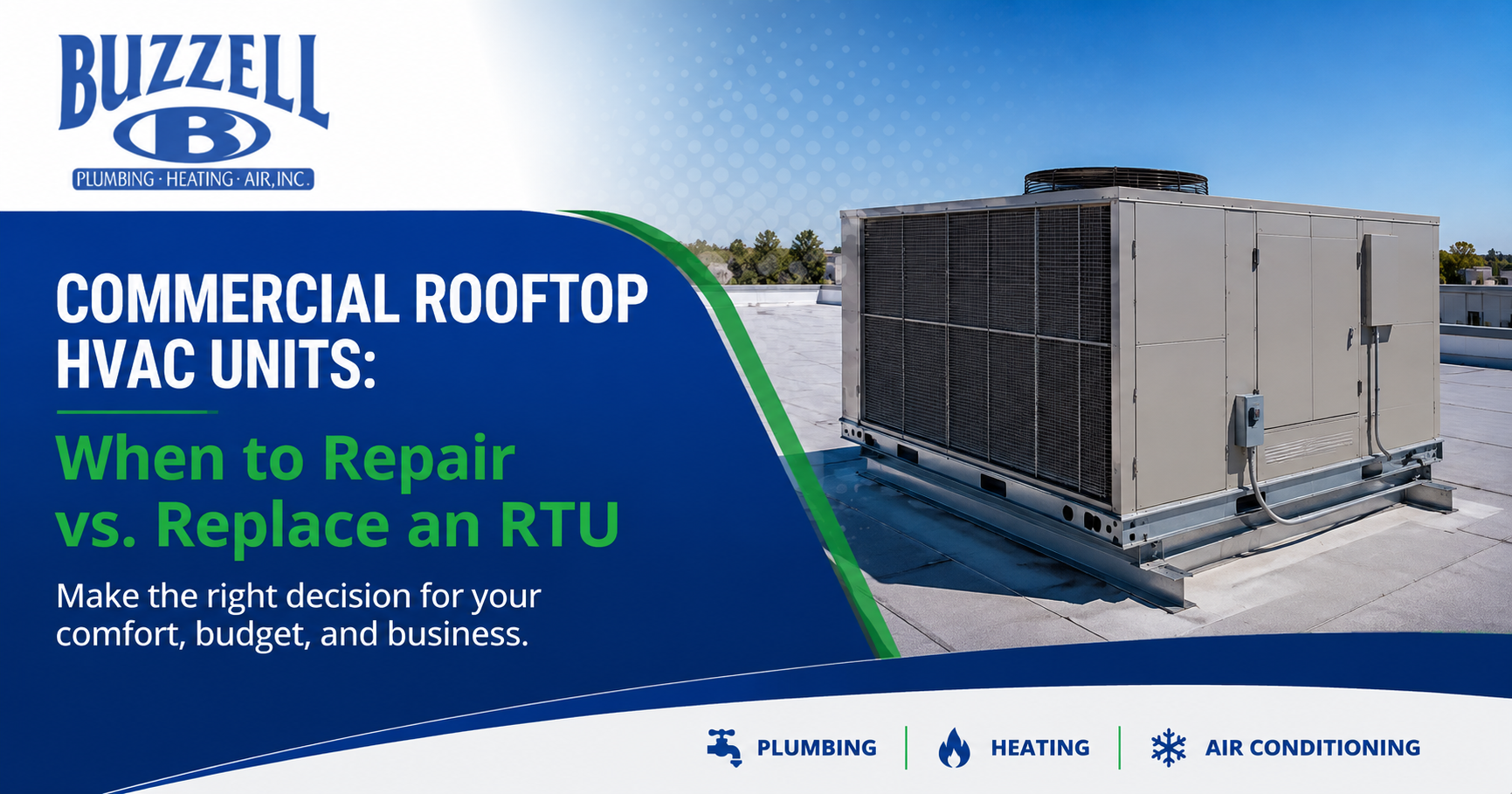
Commercial rooftop HVAC units play an important role in keeping businesses comfortable, productive, and operational. From retail stores and office buildings to warehouses and other commercial facilities, rooftop units provide heating and cooling while keeping valuable mechanical equipment out of the way. Like any HVAC equipment, however, a rooftop unit will eventually experience wear and require repairs. At some point, building owners and facility managers face a more difficult question: Does it make sense to keep repairing the existing unit, or is it time for a replacement? Understanding the condition, age, performance, and repair history of your commercial RTU can help you make that decision before an unexpected failure disrupts your business. What Is a Commercial Rooftop HVAC Unit? A rooftop unit, commonly called an RTU, is a packaged HVAC system installed on the roof of a commercial building. Unlike systems that have separate indoor and outdoor components, an RTU typically houses many of the primary heating and cooling components within a single cabinet. Depending on the system and building, an RTU may provide heating, cooling, ventilation, or a combination of these functions. Conditioned air is distributed throughout the building using ductwork. Rooftop units are common in commercial facilities because they conserve indoor space and provide technicians with convenient access to mechanical equipment without requiring significant disruption inside the building. However, exposure to heat, rain, wind, debris, and changing weather conditions can contribute to wear over time. Routine commercial HVAC maintenance is important for identifying problems before they lead to more significant equipment failures. How Long Do Commercial Rooftop HVAC Units Last? There is no single lifespan that applies to every commercial RTU. Equipment quality, installation, operating conditions, maintenance history, usage, climate, and building demands can all affect longevity. A heavily used rooftop unit serving a busy commercial property may experience different wear than equipment operating under lighter conditions. Lack of maintenance can also shorten equipment life by allowing relatively minor problems to place additional stress on major components. Instead of relying on age alone, businesses should consider age alongside the unit's overall condition and performance. An older RTU that has received consistent professional maintenance may still have useful service life remaining. On the other hand, a system experiencing frequent failures, poor performance, and increasing repair costs may warrant replacement sooner. Signs Your Commercial RTU May Need Repair Not every rooftop HVAC problem means you need new equipment. Many issues can be addressed through professional commercial HVAC repair, particularly when the equipment is otherwise in good condition. Signs that your RTU may require service include: Unusual noises during operation Weak or inconsistent airflow Difficulty maintaining the desired indoor temperature Unexpected increases in energy consumption Short cycling or unusually long operating cycles Hot and cold areas throughout the building Unusual odors from vents Frequent thermostat adjustments Water or moisture around HVAC components Unexpected system shutdowns Scheduling service when these symptoms first appear can help prevent a smaller problem from becoming a more expensive failure. When Does Repairing an RTU Make Sense? Repair is often the practical choice when the rooftop unit is relatively young, has been maintained consistently, and has not developed a pattern of major failures. For example, replacing a worn component may restore reliable operation without requiring a larger capital investment. A commercial HVAC technician can evaluate the equipment and determine whether the issue is isolated or an indication of broader deterioration. The unit's repair history is particularly important. One repair does not necessarily indicate that a system is nearing the end of its service life. But if technicians are being called repeatedly for different problems, those individual repair costs can begin adding up. Facility managers should keep records of maintenance visits, repair expenses, equipment performance, and recurring issues. This information makes it easier to evaluate the long-term cost of continuing to operate an existing RTU. When Should You Consider RTU Replacement? Eventually, repairing aging commercial HVAC equipment may provide diminishing returns. Replacement can become the better long-term option when several warning signs occur together. Frequent Breakdowns An RTU that requires repeated service calls can become both expensive and disruptive. Even if individual repairs seem manageable, recurring failures can create unpredictable operating costs. For businesses, downtime is another important consideration. HVAC failures can affect employees, customers, tenants, equipment, inventory, and normal operations. Rising Energy Costs Older or poorly performing HVAC equipment may have to operate longer to maintain comfortable indoor conditions. If energy consumption continues increasing without a clear explanation, the HVAC system should be evaluated. Problems such as dirty components, airflow restrictions, failing controls, duct issues, or mechanical wear may be responsible. When those problems are tied to an aging RTU, replacement with appropriately selected equipment may provide better long-term performance. Major Component Failure The cost of the repair should always be considered in relation to the value and expected remaining life of the equipment. Investing heavily in an older system may make less financial sense if additional components are likely to fail in the near future. A professional evaluation can help determine whether the repair is likely to extend useful service life or simply postpone replacement. Inconsistent Building Comfort An RTU should be able to maintain appropriate temperatures throughout the areas it serves. Persistent hot spots, cold areas, airflow problems, or difficulty maintaining temperature can indicate several possible issues. The problem may involve the equipment itself, ductwork, controls, building changes, or system sizing. Before replacing an RTU, the underlying cause should be identified so the new equipment addresses the actual needs of the building. Look Beyond the Initial Cost of RTU Replacement The upfront cost of commercial HVAC replacement is understandably a major consideration, but it should not be the only factor in the decision. Facility managers should consider the total cost of continuing to operate the existing system, including: Current repair expenses Expected future repairs Energy consumption Maintenance requirements Risk of unplanned downtime Equipment reliability Building comfort Remaining service life For some facilities, continuing to repair an existing RTU is financially reasonable. For others, replacement provides greater predictability and reduces the risk associated with aging equipment. Planning ahead also gives businesses more time to evaluate equipment options and budget for replacement instead of making a rushed decision after a complete system failure. Preventive Maintenance Can Help Extend RTU Life One of the best ways to get more value from commercial rooftop HVAC equipment is to maintain it consistently. Preventive maintenance allows technicians to inspect the system, identify developing issues, clean critical components, check operating conditions, and address wear before it causes more significant problems. Routine service also gives facility managers a clearer picture of equipment condition. Instead of discovering that an RTU is near the end of its useful life when it suddenly stops working, businesses can plan future replacements as part of their capital budgets. For properties with multiple rooftop units, this can be particularly valuable. Equipment replacement can potentially be prioritized based on condition and business needs rather than waiting for several aging systems to fail unexpectedly. Get Professional Guidance for Your Commercial RTU Deciding whether to repair or replace a commercial rooftop HVAC unit requires more than looking at its age. Repair history, operating costs, equipment condition, building requirements, and the risk of downtime should all be considered. Buzzell Plumbing, Heating & Air provides commercial HVAC services for businesses throughout Middle Georgia, including rooftop units, packaged systems, split systems, heat pumps, VRF systems, building controls, maintenance, repair, and replacement. If your commercial RTU is experiencing recurring problems or you are unsure how much service life it has left, having the equipment professionally evaluated can help you plan your next step. Contact Buzzell Plumbing, Heating & Air to schedule commercial HVAC service and keep your building's heating and cooling systems operating reliably.
By Lauren Scott • August 19, 2026
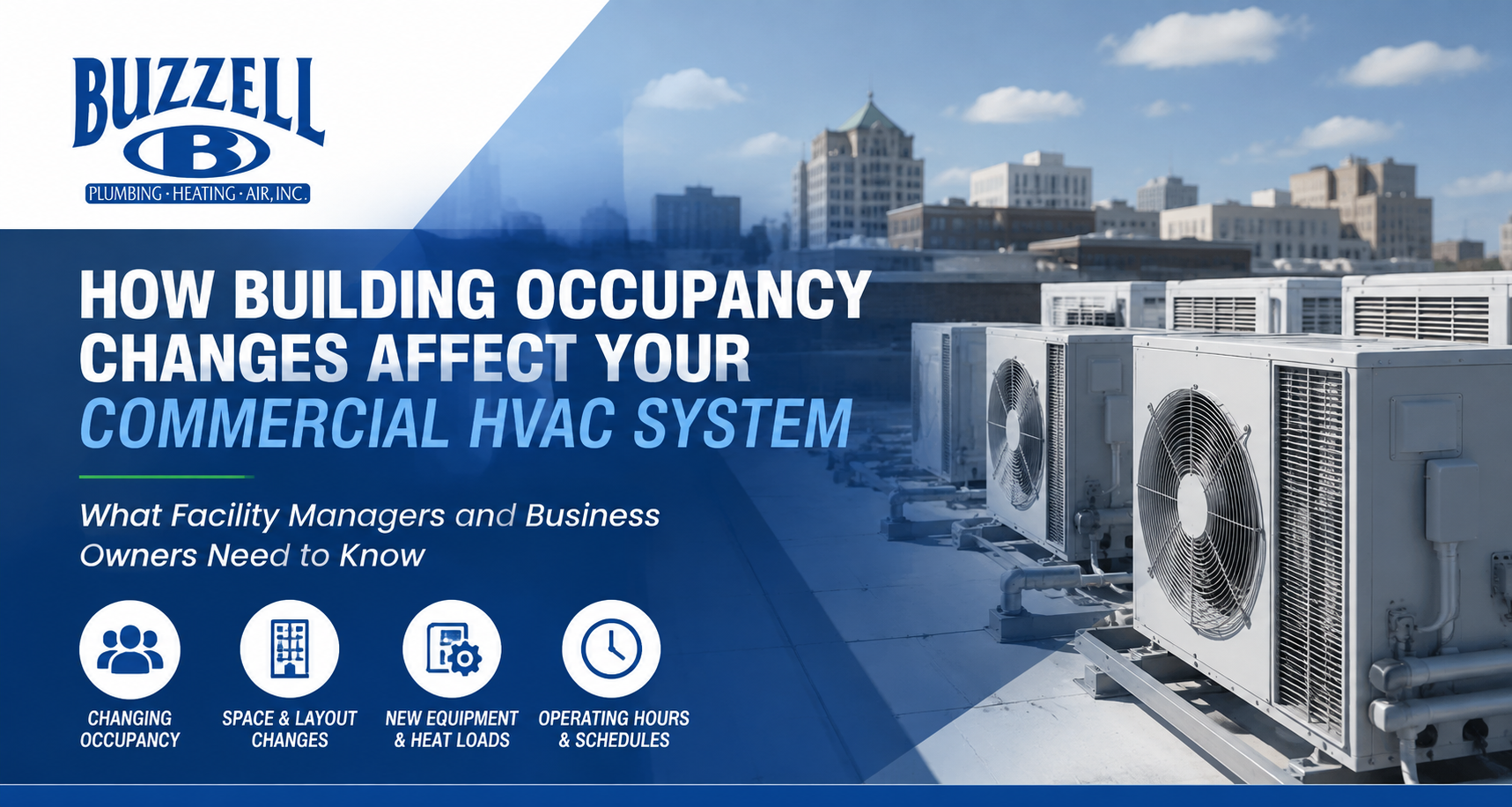
Learn how changes in occupancy, layouts, equipment, and operating hours can impact commercial HVAC performance, comfort, efficiency, and energy costs.
By Lauren Scott • August 11, 2026
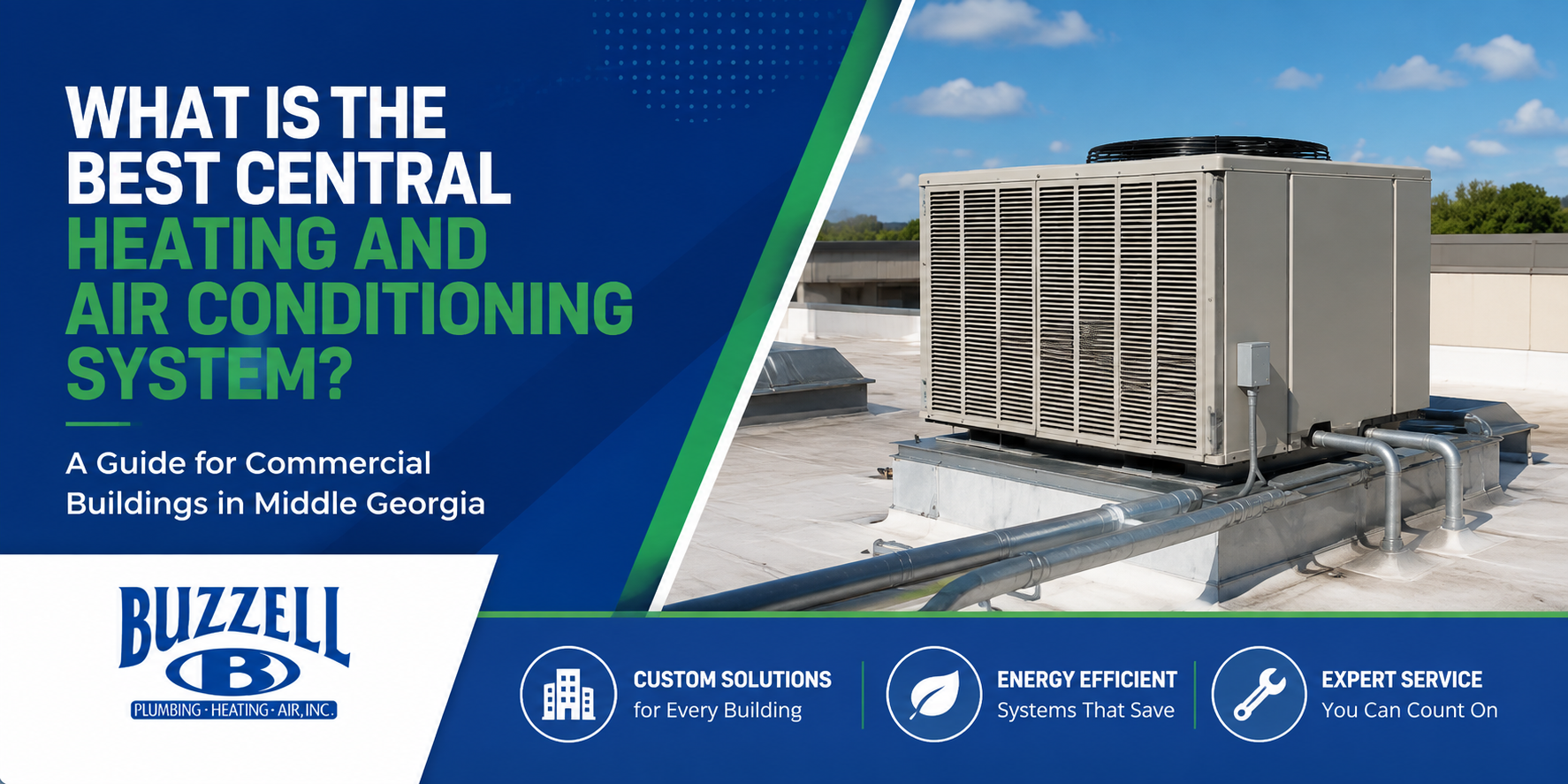
Learn what the best central heating and air conditioning system is for your commercial building and what to consider when choosing the right HVAC solution.
By Lauren Scott • August 4, 2026
Learn when to repair, retrofit, or replace your commercial HVAC system. Buzzell helps Middle Georgia businesses maximize performance and reduce costs.
By Lauren Scott • July 27, 2026
Experiencing uneven home temperatures in Columbia, SC? Learn the common causes of hot and cold spots and how Buzzell can restore comfort to every room.